
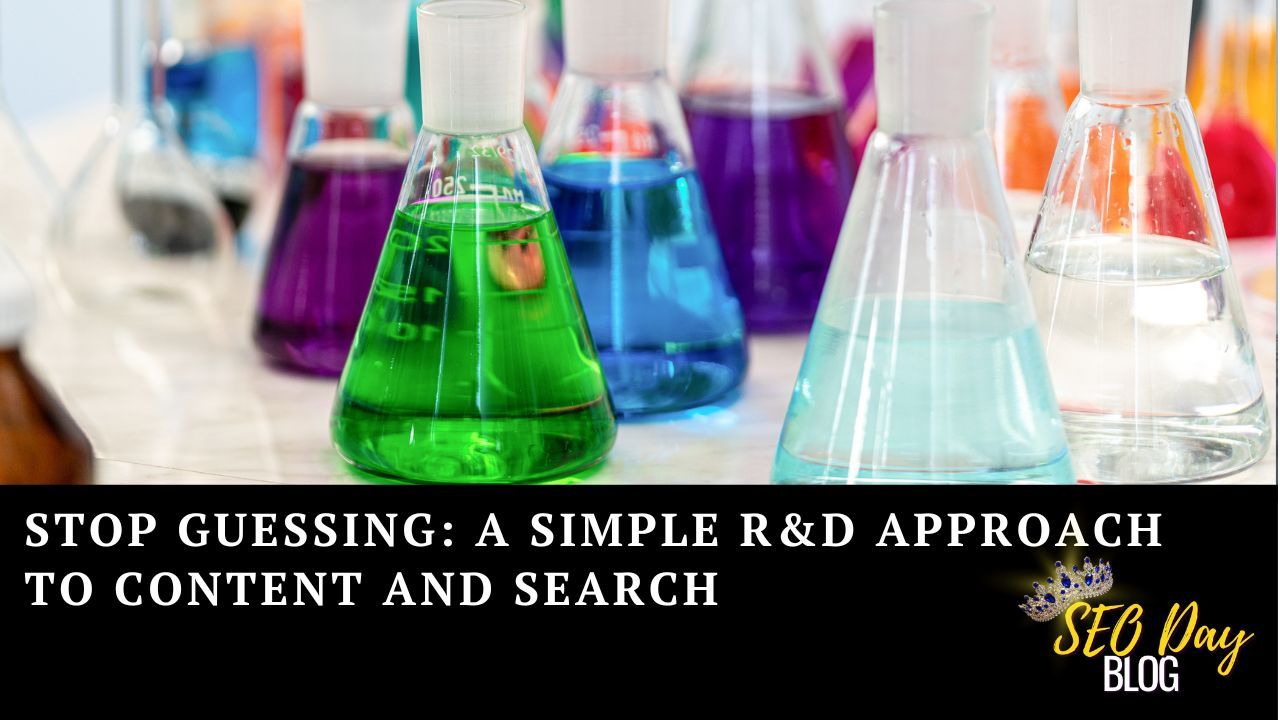
How To Treat Your Content Like R&D (And Test Your Way To Better SEO)
- They think of an idea
- Write a post or record a video
- Hit publish
- Cross their fingers and hope it works
If it doesn’t, they assume:
- “The algorithm is against me.”
- “People don’t want this.”
- “SEO is too advanced for me.”
The real problem isn’t their business. It’s that they’re treating content like a one‑time guess instead of an experiment.
In this post, I want you to start seeing your content as research and development (R&D) for your SEO and marketing.
Content as an R&D lab
When bigger brands talk about R&D, they’re talking about:
- Testing ideas
- Learning from results
- Improving based on what works
You can do the same thing with your content, even as a beginner. Instead of asking, “Was this post a success or a failure?” you start asking, “What did this post teach me?”
The goal is not to get it perfect on the first try. The goal is to keep learning.
Here’s a simple 3‑step way to do that.
Step 1: Research – start with one core problem
Pick one core problem your audience has.
If you help beginner entrepreneurs with tech and content, that could be:
-
“I don’t know what tools I actually need.”
-
“I’m overwhelmed trying to show up everywhere.”
-
“I don’t know what to publish to support my new offer.”
Then, brainstorm 5–10 different ways they might search for or talk about that problem:
-
Look at real language from DMs, emails, and comments
-
Listen to how they describe it on calls or in communities
-
Write down exact phrases, not polished marketing copy
You might end up with phrases like:
-
“simple tech stack for new business owners”
-
“how to set up my first online offer”
-
“content plan for launching my first digital product”
-
“what tech do I need to sell a course”
These phrases become the starting point for content experiments.
Step 2: Develop – create different angles on the same problem
Next, turn those phrases into multiple types of content around the same core issue.
For example, for “simple tech stack for new business owners,” you might create:
-
A how‑to article: “How To Set Up A Simple Tech Stack For Your First Online Offer”
-
A mistakes post: “5 Tech Decisions New Business Owners Regret (And What To Do Instead)”
-
A case study: “How [Client] Launched Their First Offer With A Simple 3‑Tool Setup”
-
An FAQ: “Do I Really Need All These Tools? Your Tech Questions Answered”
-
A tools list: “The 4 Tools I Recommend For Your First Digital Product”
Each piece is a small experiment.
You’re testing:
-
Which angle your audience connects with
-
Which format works best for them (how‑to vs mistakes vs story)
-
Which topics pull people deeper into your world
Same core problem, slightly different approach each time.
Step 3: Review – pay attention to what actually happens
After you’ve been publishing for a few weeks, pause and review.
Look for patterns:
-
Which blog posts or emails got more clicks or higher open rates?
-
Which pages had people staying longer instead of bouncing right away?
-
Which topics got replies, DMs, or questions?
You don’t need perfect analytics to see this. Even simple tools will show you:
-
Top‑viewed pages
-
Popular links
-
Posts that sparked conversation
That is your R&D data.
Instead of guessing what your audience wants, your content is giving you clues.
Double down on what works
Once you see which topics and angles performed better:
-
Update the posts that did well
-
Improve the headline
-
Add a clearer call‑to‑action
-
Clarify sections that people might skim past
-
-
Create follow‑up content on the same themes
-
A deeper dive on that topic
-
A part 2 or “advanced” version
-
A related checklist, template, or resource
-
-
Link related posts together on your site
-
Turn them into a mini‑series or resource hub
-
Make it easy for someone to go from one helpful article to the next
-
Over time, those clusters of content become the core paths people follow to work with you.
Search engines also start to see:
-
You talk about these topics a lot
-
People engage with them
-
Your site has depth and usefulness around those problems
That’s exactly what helps your rankings improve steadily.
Why this works so well for beginners
If you’re new in business, this R&D mindset helps you:
-
Take pressure off every single post
-
Turn “flops” into useful feedback instead of failures
-
Build your SEO in a way that matches how your audience actually behaves
You’re not trying to “hack” search.
You’re learning what your people want and giving them more of it.
Where to Begin
Here’s how to start, simply:
-
Write down one core problem your audience has.
-
Brainstorm 5–10 ways they might search or talk about it (use their real words).
-
Pick 2–3 of those phrases and plan 2–3 simple pieces of content (how‑to, mistakes, FAQ, story).
Then, after a few weeks, look back at:
-
What people clicked
-
What they spent time on
-
What they responded to
That’s your content R&D at work. You’re not just “doing SEO” anymore. You’re running experiments that make your strategy smarter every single month.
Where Do You Go From Here?
Choosing great keywords isn't about finding one perfect phrase.
It's about understanding the people you want to help, the questions they're asking, and creating content that makes it easier for them to discover you.
If you're wondering where to begin—or you're not sure whether you've built the right foundation for a successful SEO strategy—the SEO Readiness Quiz is a great place to start.
In just a few minutes, you'll discover where you are today and identify your strengths toward becoming easier to find online.
Then, when you're ready to put that insight into action, you can use your reserved free seat at the SEO Roadmap Workshop to help you turn your quiz results into a simple, realistic SEO strategy. Together, we'll identify what matters most for your business, what can wait until later, and how to make steady progress without feeling overwhelmed.
You don't have to learn everything at once.
You just need to know your next step.
You absolutely can do this.
Small Steps. Real Progress.
More on Keywords, SEO & Findability
Why Stubborn Keywords Stall Your Growth - And What to Do Instead
Categories
Author

Denise Millet
I am on a mission to help entrepreneurs get the content they spend hours creating included in search engines, so when their customers search online, they're findable because if they can't find you, they can't do business with you.
Recent Posts